North Korea: the Beginning of the End

In the preface to ‘Communism: A Very Short Introduction’, Leslie Holmes writes:

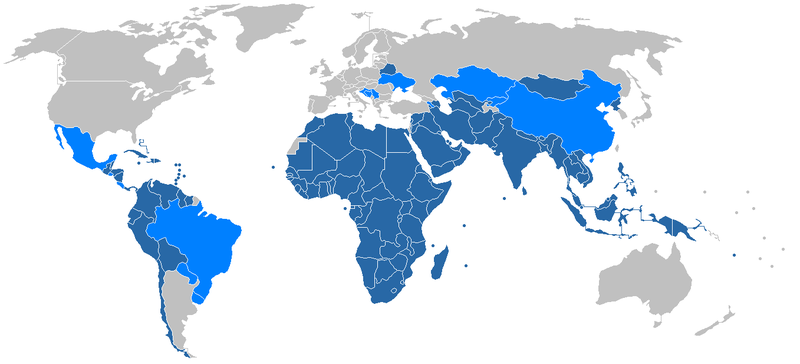
‘The overwhelming majority of states that were Communist as recently as the late 1980s have moved on. While, formerly, five communist states remain, the two successful ones (China and Vietnam) are so largely because they have jettisoned many of the original basic tenants of communism and are in some important areas – notably the economy – already post-communist’.

The communist world today

The communist world today

First published in 2009, such a view presented in Holmes’ book is already proving to be especially discerning. Only in late 2014 did the USA and Cuba set aside their long-enduring hostility towards one another, an action which, as I’ve earlier said, I believe will mark the start of socialism’s decline in the Caribbean. Arguably, with China and Vietnam already long gone, this leaves just one state that exists according to strictly socialist principles; North Korea, or officially the Democratic People’s Republic of Korea (DPRK).

Ironically, what could be perceived to be the last untarnished communist regime has formally abandoned communist philosophy, a political step on the road to capitalism which the other four countries have yet to take, with their constitution of 2009 describing their country as one ‘guided in its activities by the Juche idea and the Songun idea’. However, Juche, the school of thought based upon ideas of self-sufficiency, and Songun, the national policy of ‘military first’, contribute little in the way of altering the country’s strictly-centralised economy. From the outside, it would appear that the economic situation has persisted without interruption, leaving a country with an equally ‘communistic’ system to the other four, and even more so today, with the relaxations in policy within China or Vietnam. But is all this about to change?

A surprising event in recent news may indicate exactly that, depending on what angle you look at it; North Korea is currently experiencing a nationwide property boom, a concept we’d associate with the capitalist west. In itself, this may not provide a strong enough argument to suggest a foreshadowing of the regime’s collapse, but an article published in the South Korean newspaper ‘The Hankyoreh’ explains how this may be the case. The author references research professor Jung Eun-yi, a leading expert in the field, who ‘argues that there are signs that the housing market in North Korea is turning into a real estate market, rather like South Korea’.

Verkehr_in_Nordkorea_06

As I’ve said, it’s still only a minor alteration, yet change has to begin somewhere, and it isn’t always as dramatic as the Romanian Revolution of 1989, or even the lifting of the trade embargo against Cuba by the USA. Furthermore, it shouldn’t be underestimated how provocative such a change could be; the article explains how Jung believes this style of market ‘will continue to expand for a significant period of time’, allowing it time to seriously transform the nationwide economy, paving the way for further relaxations on the road to a free market. In short, we learn that Jung thinks 2013’s establishment of the housing delegation offices proves that ‘both central planning and market forces are at work in the North Korean economy today.’, and that, in her opinion, the incorporation of the latter alongside the former into the market also provides evidence for a reformist trend developing under Kim Jong-un’s government; she informs us that ‘the regime is going beyond the military-first policy known as Songun that was instituted by Kim’s father and moving down the path toward socialist capitalism’.

The timing certainly seems right, with the DPRK standing as the last of its kind, and I believe this is exactly the kind of trigger such transition requires. Once more opportunities arise for personal financial gain, enabling the individual, rather than the state, to profit, the iron grip the government maintains over the economy will begin to loosen; like the other socialist states whose colours have somehow clung to the mast after the dissolution of the Soviet Union and the fall of the Berlin Wall, the DPRK’s regime shall eventually crumble. One question, however, remains unanswered: is the fall of Korean communism to be rejoiced or lamented?

There’s obviously no one answer, and it depends not only on your attitude towards communism on the whole, but also towards the North Korean regime. I can’t imagine many conservatives, liberals, or even socialists saddened at the prospect. A dispute could arise among the far left, however, and opinions on North Korea vary from a communist perspective.

Personally, I’d definitely support the ousting of the current leadership, which operates as an absolute monarchy, enjoys luxurious privileges unheard of by the workers it claims to represent, looks to the leader like a prophet, Kim Il-sung like a God, and all in a perverted fashion which contradicts multiple tenants of Marxism. As for the loss of a communist system in the economic sense, I feel much the same as I did for the potential loss of Cuba’s. Yet it doesn’t take an expert to realise that the North Korean system is already flawed, given the famine it produces, the corruption it’s tainted by, and the seemingly endless funding it directs towards the military at the expense of the populace. In fact, if you take all its flaws into consideration, it would even seem sensible to argue that North Korea’s economy has already strayed too far from the communist model it was built upon.


The featured image was provided by User:SKopp from Wikimedia Commons. It was licenced under the following: http://creativecommons.org/licenses/by-sa/3.0/deed.en

The image depicting the current communist states was provided by Ichwan Palongengi from Wikimedia Commons, and was also licenced under the above.

The image depicting the apartments in North Korea was provided by Nicor from Wikimedia Commons, and was also licenced under the above. 
On Patriotism

As I write, patriotic thought is on the rise.

From the nationalist, anti-US current developing in Russia to the successes of far-right parties across the UK with the increase in foreign immigration, the country one belongs to surfaces more and more amongst other political issues. The reason behind this is probably due to a variety of factors, perhaps as a reaction against the political and economic unions of today, such as the EU, or in the form of national self-determination, opposing the rule of other nations, such as in Scotland or Kashmir. It would thus seem difficult to make assumptions or generalisations for such a vague and simple manner of political thought, though there is an underlying definition to be understood.

If you simply type in the word ‘patriotism’, here’s what Google will give you:

patriotism

 /ˈpeɪtrɪətɪz(ə)m/

 Noun

  1. the quality of being patriotic; vigorous support for one’s country.

“a highly decorated officer of unquestionable integrity and patriotism”

In the entry ‘Nationalism, Imperialism, and Communism’ I made clear my hatred for nationalism. Today, against the backdrop of increasingly-patriotic world, I’ll take that one step further and explain why I believe patriotic thought, even in casual circumstances, is unhealthy, damaging, and also completely irrational.

Take Russia for an example, a country in which ‘vigorous support for one’s country’ is actually able to translate itself into ‘hatred of another’. Is this not proof that patriotism is a corrupting manner of thought; one that is able to completely distort perceptions of the world? It would even be possible for any leader could cultivate such a force, using it to brainwash their population and justify inhumane actions ‘for the glory of the motherland’. Patriotism, capable of arising in any country under any regime, can serve to counteract the process of fair, logical decision-making, when an individual will side with their country no matter what. Even ‘weaker’ patriots, happy to draw limits on their support for the nation, fall into the same trap: if you belong to a country, if you believe in that country, then imagine how readily biased you’d be in the need to choose a side.

This can be clearly seen in the example of the Vietnam War, in which many atrocities, violations of international treaties, and inhumane acts of violence were committed by the United States in the invasion of an innocent country thousands of miles offshore. This war in particular suffered a great deal of internal opposition, yet a proportion of society managed to be persuaded, and that was enough. If these people were born without a nationality, without any reason to side with the U.S. government, I’m certain that fewer would chose to do so. Thus, many that could prevent authorities from committing such atrocities do not, merely because they blindly support the country of their birth, for no real reason whatsoever.

Yet this isn’t even the worst of it; to develop a true understanding of this idea, I believe it’s necessary to consult history, and what does this tell us?

Well, as you might have expected, it’s not good news…

The twentieth century saw the establishment of patriotism in its most extreme format, with the global rise of fascism. A fascist regime is an example of patriotism taken to the furthest extent possible, with nationalistic thought not only embedded in the regime, but existing as the basis upon which the government, the military and the economy all stand. The ideas that motivated Hitler, Mussolini or Franco were not only patriotic in nature, but they placed the idea of national glory where the communists of the day placed the achievement of a classless society. In other words, they valued their nation more than anything.

Bundesarchiv_Bild_146-1980-081-05A,_Postkarte,_-H.J._Schwaben-

To reach conclusions, however, we must look at the regimes from which these movements arose, for a trend between fascist nations such as the Third Reich, Mussolini’s Italy or imperial Japan is clearly visable: each one of them quite simply formed out of a miserable society. This could be due to a disaster, such as the horrific earthquake experienced by Japan in the 1920’s, which has been thought to have sparked the rise of Japanese imperialism, or just a general want for change, such as that in post-1918 Germany. Either way (doubtless, there are also many other ways), we can see a trend developing here. Nationalism, like a political tumour, has a tendancy to arise out of chaos. It ties the people of a nation together using an already-existing middle ground, and gives them something to believe in when nothing else will. It isn’t surprising then, that Germany and Italy (two nations where nationalism burned as brightly as ever) were countries in which a revolution was most expected. Instead of staging one, however, the people resorted to an easier form of change, looking to nationalism as a ‘cheap’ alternative.

Whilst these three countries are obviously extreme examples, it says a great deal on patriotism in general. The idea develops as a creed the populace will turn to when they have nothing left to believe in, so they chose to place their faith in the most simple idea available, this being their own country. It has the potential to curb real political change and distracts the population from the truth of the matter, despite how appaling such truth may be. Just look at the military, who often endure horrific conditions whilst living in fear of their lives, and desperately need something to believe in, something to fight for, something which enables them to keep pushing on. It’s thus no surprise that patriotism is not only rife among the fighting forces but is implemented artifically by those in command.

Patriotism_Runs_True_at_380th_Air_Expeditionary_Wing_in_Southwest_Asia_DVIDS287854 (1)

I think I’ve made my point clear as to why such thought is far from healthy and should be considered dangerous, but I’d like to finish by pointing out the true nature of the idea, and why this is relevant in discussing the concept.

What does it mean to be a patriot?

For the simple definition of the term, the one given above is adequate, yet what a ‘vigorous support for one’s country’ actually consists of is an entirely different matter.

I’d consider it vital to understand that ‘one’s country’ consists of no more than several hundred square kilometres inside an artificially-drawn borderline, somewhere in which they live their life. It may sound like a romantic idea, yet the actuality is plainly ridiculous, despite how many continue to cling to it.

On that note, coming back to the UK, several informative leaflets on the United Kingdom’s Independence Party (UKIP) recently came through my door in the run-up to the General Election. Reading through what the party had to say, I noticed that the slogan ‘Believe in Britain’ was used (well, in fact it was proudly displayed in capitals).

‘Why?’ I found myself asking. ‘What is there to believe in about Britain? In itself, the United Kingdom is merely a relatively small nation-state off the North-western coast of Europe. Within this country there are many greats, yet there are also many wrongdoers, and I’m not too sure what makes the general spread of the population so special. Perhaps you should tell me to ‘Believe in UKIP’, but what is there to glorify about one country out of hundreds, which just so happens to be the one in which I live and which you intend to govern?’

It certainly seems odd. Surely we’re too intelligent a being to devote ourselves entirely to an area of land, simply because it was one we grew up on, or live in today.

Sadly though, this just isn’t true.

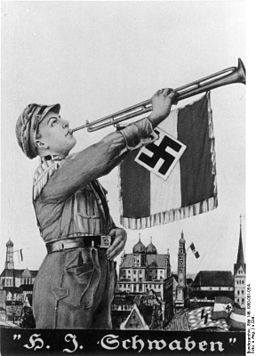
The image depicting an individual playing a brass instrument was provided by Wikimedia Commons, on which it was uploaded by the German Federal Archives under the following licence: http://creativecommons.org/licenses/by-sa/3.0/de/deed.en

The Pull of the Centre

As all the voters in the UK will know, May the 7th is approaching and tensions are running high. The first TV debate between party leaders has been aired, the first signs of future change on ground level appearing, and policy announcements are growing even more forceful, more desperate, as the day nears.

Of course, I’m talking about the British General Election, but I’m not about to take a side. Rather, I’m writing to talk about the turning point this election presents, and what it could mean for the future of British politics. Specifically, I want to address the question brought forward by the establishment of the current coalition government: is traditional left/right politics in Britain on the decline?

One thing is becoming increasingly clear: the coalition established after 2010’s vote was cast is the first to have arisen since 1945, yet it seems unlikely that this shall be the last. The usual distinctions between a Labour and a Conservative voter are wearing away rapidly, possibly alongside the obvious social distinctions that once separated the two groups, and it now seems inconceivable that the population could be divided between the supportive realms these two parties once possessed. Really, if we look at it from this angle, it doesn’t seem surprising that nobody in 2010 could secure an outright majority, and it suggests that nobody will this year either, but what does this say about the future of party democracy?

256px-David_Cameron's_visitEd_Miliband_(2010)_cropped

The latter half of the previous century has seen, among many other phenomena, party politics drift slowly towards the centre; once in a position where they could be viewed as the country’s answer to the radical European worker’s movements on the eve of the Russian Revolution, the Labour Party has grown so moderate in their approach that they could be seen to have rejected socialism entirely; once truly conservative, the Conservative Party recently legalised homosexual marriage, straying far from what once were core, underlying values of traditon and, well, conservatism. Assuming such a trend continues, we can logically predict a point in the near future where the current necessity of a party to vote for is no longer apparent, where left/right politics is no longer existent. So, to answer the question, I believe that the political divide in Britain is, in fact, on the decline, and has been for some time.

I understand that this view seems contradicted by the increase in popularity of smaller parties (The Green Party or the United Kingdom Independence Party providing examples in Britain’s case), which are often more firmly rooted in the philosophies that once drove the Labour or Conservative parties. I wouldn’t see this as a contradiction to my view, rather a side-effect of the model that it proposes. In other words, I believe it’s natural that as the mainstream parties lose their ideological ground, vast territories in the left and right are left unoccupied, which other movements will rise to claim. I don’t, however, believe that the cycle will repeat, that UKIP will become the ‘new Conservatives’, and I think the fact that no serious movement on the left or right has arisen proves this; all we are seeing is splinter factions take a temporary stand as the original political ties fragment, as the original divisions crumble, but they too will either move towards the centre or be reduced to insignificance.

On that note, if such a trend represents the political situation of western democracy as a whole, rather than just a one-time occurrence in Britain, then the UK as a country is by no means at the forefront of this change. Europe, for example, is a continent used to the rule of coalition governments, even those which constitute polar opposites. Just look at Greece, in which the latest General Election brought to power a coalition between a radical leftist, neo-communist party and a centre right movement, linked only by their opposition to austerity imposed by the European Union.

So, if such change, is occurring worldwide, and democracy is slowly becoming a battle between individuals rather than ideologies, then what can be done about it? Should we resist the change? Should we back the smaller, radically orientated parties just to repel the pull of the centre? I suppose it’s up to you, but the way I see it, there’s not a lot we can do to change things. I believe that, like the issues caused by voting inequality roughly a century ago, we’ll get over this issue by confronting it head-on.

Of course, I may be entirely deluded, in which case there’s nothing to worry about, and even if I’m right, it can’t be all bad news; it may even be refreshing to break the ties people once had with their parties. After all, this needn’t be viewed as the end of one political era. Rather, you could see it as the start of a next.

Either way, keep voting and we’ll soon see what happens!

The image of David Cameron was provided by the user ukhomeoffice from Wikimedia Commons.

The image of Ed Miliband was provided by the user Ed Miliband for Leader, also from Wikimedia Commons.

Both images are licensed under the following:

http://creativecommons.org/licenses/by/2.0/deed.en

The Third ‘Bloc’ That Never Happened: Tito and the Non-Aligned Movement

The idea of socialism outside of the Eastern Bloc has surfaced multiple times in history, perhaps most famously among the communist left, and later the followers of Mao Tse-tung or, to a lesser extent, Che Guevara. It will have undoubtedly intrigued many intellectuals and revolutionaries since the birth of the USSR, one of whom I will focus on in particular…

Josip Broz Tito, the Croatian-born leader of Yugoslavia did something both extraordinary and also somewhat reckless, which, I’ve decided, shall be the subject of this entry: he led the first state in Eastern Europe, then in the grip of Soviet influence, to become ‘socialist, but independent’.

Josip Broz Tito

What relevance does this have? Well, April is the month which, twenty-three years ago, saw the breakup of the Socialist Federal Republic of Yugoslavia. On April 28th, 1992, Serbia (the last of the Yugoslav republics) became an independent nation, serving as the final nail in the coffin for the great communist federation of South-eastern Europe. This was a country fundamentally different to many others: it was among the first to have been liberated by the Red Army, yet to reject the USSR, and operated under the system that could have been described as ‘council communism’, where worker’s councils and unions would provide the basis for socialist transformation, which could be seen in contrast to that of the Soviet Union.

Yet equally interesting are the social and political ideas of international socialism Marshall Tito upheld, for he was an active member, and later leader, of the Non-Aligned movement. This is an ongoing organisation representing the interests of developing countries, with the founding aim of ‘opposing imperialism and neo-colonialism, especially from western domination.’ Such an idea was most apparent in the Cold War’s polarisation of political identities, with the desire to create an ‘independent pathway’ for these states so that they would adhere to neither the USA nor the USSR.

I’ll say this now: this entry is not an opinionated one; I won’t go into depth about my personal views on the subject or on the political views of Tito generally. Rather, I’m writing discuss this idea of an ‘independent pathway’, and its relevance to both communism and capitalism respectively.

The Movement's Member States

The Movement’s Member States

Coming back to the Cold War, it couldn’t have been a more interesting time to consider a third power arising in the world, combatting both the Eastern and Western Blocs with a newly-developed idea of proletarian internationalism. It would also provide an opportunity to oppose what could have been perceived as Soviet imperialism (a particular criticism which did gain a degree of popularity) whilst remaining true to the principles of communism. In other words, you would no longer have to bear the label of ‘Soviet sympathiser’ to consider yourself a communist.

In the latter half of the previous century, however, history seems to have had other ideas. The two ‘Blocs’, the great realms of power split Europe down the middle similarly to how the Triple Entente once calved Imperial Germany and its neighbours out of the rest of the continent, only such a division was far clearer easily distinguishable now that it adopted political connotations. Yet it was surely obvious that such a scenario, this is to say Europe’s division into a communist east and a capitalist west, could never have been a permanent situation, making the arisal of a third power bloc perfectly possible. Why then, in a climate of hate and tension, when a third way was definitely on the cards, didn’t this new union form?

I’ve been thinking, and here are the reasons I’ve managed to come up with:

Five Reasons as to Why the ‘Third Bloc’ Never Arose

  1. A lack of information of Marxist philosophy or communism as a political theory within these countries (especially in the less-well-developed nations).
  1. A lack of the necessary conditions for communist revolution due to the existence of less-advanced methods of production.
  1. The development of a view picturing both west and east alike as ‘similarly evil’ threats to these nations and cultures, without adequate consideration of the political climate, and thus the demand for the national sovereignty against the two powers compromising proletarian revolution.
  1. The division of these nations by the two powers, directing them against each other and against the respective power blocs, as the west and the east’s sphere of influence adapts the political climate of these countries to their immediate needs, an example of which would the United Kingdom’s influence over the former British colonies.
  1. The tendency of the division separating the capitalist and the communist world to polarise political thought worldwide, rendering the construction of a third power increasingly difficult.

While we’re at it, we may as well look at the collapse of communism in the Eastern Bloc as well:

Five Reasons as to Why the Eastern Bloc Fragmented

  1. The development of nuclear weapons west of the division, and thus the rising possibility that a war may result in apocalyptic outcomes, preventing the socialist states from military advancement.
  1. The general lack of evidence pointing to an improvement in the economic circumstances within the communist world, causing a lack of faith and enthusiasm for communist lifestyle and the idea of reaching ‘true communism’.
  1. The decline of ideological stability among the populace as what have been recognised as capitalist principles, e.g. corruption and inequality, became apparent in communist regimes.
  1. The development of western capitalism to a stage regarded as acceptable by many of the would-be exploited in the west, internally strengthening capitalist society and removing the strong base of proletarian support the socialist states could have relied upon for revolution, or at least sympathy, within these countries.
  1. The struggle for the stagnating autocratic regimes to maintain power over the populations of Eastern Europe and the Soviet Union in the face of modernisation, coupled with the weakening of their authority in general.

I’ll finish with this thought: Tito is long dead, and Yugoslavia dissolved over two decades ago. Yet if such hadn’t happened, that is to say, if the political climate was such that the new state was able to arise, who knows what the result would be. Perhaps the proletariat of these nations would line up under Tito’s leadership, against the troops of the USA, the USSR, Great Britain, the People’s Republic of Poland, France and Hungary; perhaps the task of revolution would entail a struggle against not only the capitalist, but also the communist world.

It’s ironic, when you think about it, and fairly shameful for both sides of the Berlin Wall. Just imagine how Stalin, the man who is quoted to have said ‘I will shake my little finger and there will be no more Tito!’ would have reacted.