American Imperialism and the ‘war in Iran’

US presidential hopeful Hilary Clinton recently threatened an attack upon the Islamic Republic of Iran. As if instinctive human morals weren’t enough to dissuade her, it also seems that the Democratic candidate has learnt nothing of the controversies this kind of behaviour has sparked in the past, and she listed several reasons as to why she believes the invasion would be a justified one.

The invasion of Iran can only be described as US imperialism, something condemned not only by the socialist movement, but many people from across the political spectrum, and this action will likely be criticised not only internationally, by many in the United States as well. So, we have a smaller, largely impoverished country at the mercy of a larger capitalist giant, militarily threatening Iran for its own interests in the region. This is just the situation that unfolded in Vietnam and Iraq, and in neither example did it end well.

Yet to develop a better understanding of the situation, it’s important also to view Iran with the same critical slant. This is a country that operates as a reactionary theocracy, that employs an extremely backward and restrictive set of laws, and that doesn’t think it’s ridiculous to legally ban owning a dog, or, in certain universities, wearing bright clothes. This means that, in this case, we have an imperialist, capitalist power invading a reactionary, repressive state. Neither country occupies the moral high ground, and neither regime, in an ideal world, would receive my support.

I recently read an article called ‘Iran and the Chauvinism of American Media’, about reactions among the American public to Iran’s detaining of two US ships which entered its territorial waters, and the respective political situations (especially the media) in both countries. The article was posted on anti-imperialism.com, a far-left political blog similar to this one, and whilst I agree with its gist, I did feel that it expressed a tendency which I’d criticise: as part of a critique of US imperialism, it was as though they took to defending Iran. Not just the Iranian people, the victims of imperialism, but the Islamic Republic of Iran. If you’re endgame is communism, I think this kind of attitude is unproductive…

It is important to remember that, by Marxist logic, the revolutionary state (or, for that matter, the revolutionary) holds at heart the duty to spread the revolution worldwide. Thus, any country which falls short of the communist criteria is effectively an enemy, and should be allied with only as a means to an end. To support these states, therefore, betrays this central tenant.

Yet, in writing this, I am certainly not condoning the atrocities committed by American imperialism, and do not want to underplay their role in this scenario. As the previously-mentioned article reads, America ‘occupied two countries on opposite sides of Iran for more than a decade, extracting oil and other resources’ and imposed ‘imperialist economic sanctions since 1979’. It is obvious that these actions cannot be ignored, but to give active support to a reactionary administration should by no means be viewed as a desirable move.

This is why, when I say that in this potential situation I would defend Iran, it is purely because this way, I’m acting against a greater evil (Americah, or the ‘Great Satan’, as Ayatollah Khomeini called it). It is important not to call into the trap of sympathy, sympathy in this case meaning sympathy towards the state, rather than just those living there. To defend a nation such as Iran for any reason beyond tactical expediency is to turn your back upon the international revolution for the politics of petty centre-leftist internationalism.
The Years When Anything was Possible: a Marxist Analysis of the Twentieth Century

World War One

The Rise of Communism

The Rise of Fascism

World War Two

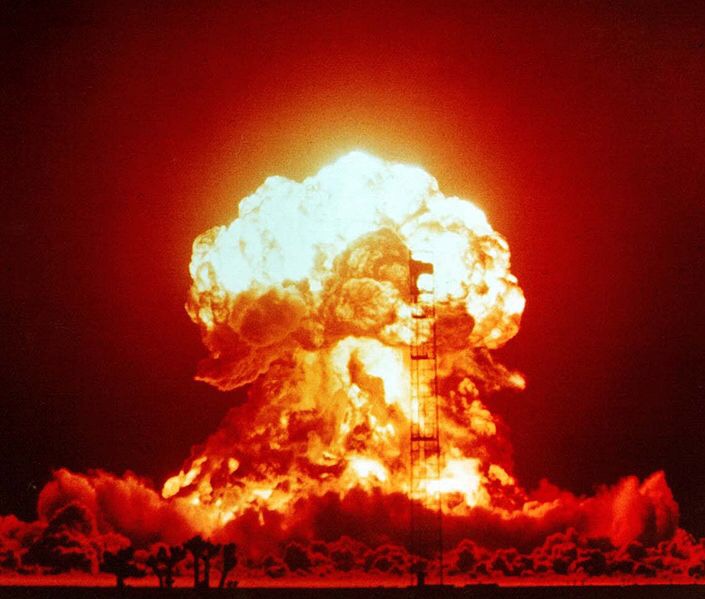
The Building of the Nuclear Bomb

The Polarisation of International Politics

The Threat of Global Annihilation

It seems like a lot to have happened within 100 years, but this was the twentieth century; ten decades which would change the course of humanity. The wars, genocides, revolutions and discoveries that took place between 1900 and 2000 demonstrate, for better or for worse, just what mankind is capable of. Sometimes, these included great technological feats, others, great atrocities, yet the twentieth century also saw something never before seen in history: man’s brilliance and creativity catching up with him.

The question is, however, why were these years so dramatic?

Take, World War One, for example. This was a war which Germany predicted long before it occurred, the causes of which, as most agree, were rooted in the geopolitical situation at the end of the nineteenth century. Thus, it would appear that this event was the result of years of tension, and that tension was released in the form of a battle. Many argue that it is because of this war that World War Two occurred, or that Hitler and Stalin came to power. If this was true then it would seem that the entirety of the drama that followed was a result of nineteenth century politics.

I, however, believe it goes deeper than that, and that the root cause of the 100 year long epic was not a singular war. The Russian Revolution is a good example, for it is an event which divided the political scene for the next seventy-four years. It may seem that this revolution only took place because of the damage done to Russia during the war with Germany, but I believe it’s more complicated than that; the ousting of the tsar was almost inevitable, and when the Bolsheviks took power, they were riding on the back of 200 years worth of social change. Perhaps the conflict provided an opportunity for revolution, but revolution would have occurred regardless.

Given that this is the case, events such as the rise of fascism and the Second World War need re-examining. There are certainly reasons that suggest the war was involved, but most agree these two events would have not happened had Europe been stable. This is why I believe that the primary cause of this 100-year-long epic was economics, or more specifically, capitalism.

The war, in fact, ties into this, for World War One was a conflict between the imperialist powers of Europe, all fighting for their own colonial interests, all in, as Lenin called it, the ‘Highest Stage of Capitalism.’ This would mean that the damage done to postwar Germany was as a result of their loss in a financial conflict. After the war’s conclusion, communism should have followed imminently, given the state of the capitalist world, and it very nearly did. The red flame was ignited in the Russian Empire, and spread to Central Asia, Eastern Europe and would have spread to Germany (look at events such as the Spartacist Rebellion), but failed.

This was because Germany’s decaying capitalist system yielded not to socialism, but fascism (or capitalism in decay, to quote Lenin). This led to another conflict, allowing other capitalist countries to strengthen military, and halting the revolution at Berlin. A great percentage of the drama, triumphs and disasters that followed are the shockwaves of the great tension in the world, as capitalism and communism stood side by side, and humanity teetered on the brink of revolution.

Yet the revolution never came, and by the early 1990s, the international bourgeois had prevailed. This was largely due to a number of factors, but perhaps the primary reasons were the immaturity of the revolution, alongside the evolutionary ability of capitalism to change and adapt. But Cold War tensions still exist in the world, and NATO still fears the morals and potential of the Russian Federation. It seems that, after communism’s departure, fresh tensions have arisen in its absence, tensions which have increased in recent years.

Should this continue, the unrest that marked the previous century may spill over into this one.

Update on the Book Launch

I realise this isn’t a Friday, but I’m writing to inform you of the dates for the London book launch. It’s happening on Saturday 27th February in the Society Club, Soho, between six and eight in the evening. Here’s the link to the shop where it’s taking place:

http://www.thesocietyclub.com/

I still don’t have dates for the York launch, but I’m hoping for Wednesday 2nd or Thursday 3rd March in Waterstones, the link for which is below. Hope to see you there!

https://www.waterstones.com/bookshops/york

Long live Bolshevism.

– AR

Beyond the Cash Economy: a Look at ‘True’ Communism

In a Marxist context, ‘true’ communism is viewed as the final stage of society, where class, profit, government and nationality have all been swept away. By this time, according to the theory, mankind will have evolved beyond hierarchical organisation and will live collectively, meaning that the Soviet Union, China, or any other communist regime does not qualify.

Rather, the socialist countries of the twentieth century belong in the ‘lower’ stage of communism, theorised as a period of transitional socialism whilst some remnants of capitalism remain. Thus, a government exists, albeit a socialist one (a ‘Dictatorship of the Proletariat’), and a socialist economy is in place, rather than a fully communist one. This, although poorly, is how the People’s Republic of China attempts to justify their market economy.

“…between capitalist and communist society lies the period of the revolutionary transformation of the one into the other. There corresponds to this also a political transition period in which the State can be nothing but the revolutionary dictatorship of the proletariat’ – Karl Marx, Critique of the Gotha Program

Yet it is perhaps because these countries don’t represent the idea (meaning that there are no examples at hand) that ‘true’ communism is rarely discussed. It is often passed off as ‘the communist’s ideal’ or the theoretical utopia which Marxism, as a philosophy, has to offer. This means that the endgame of the international Marxist movement is often only spoken of in contrast to what is seen as communism’s harsh reality, yet few understand that this ideal occupies a hypothetical epoch of its own, one later in time than the stage of development occupied by, say, the USSR. Thus, the theoretical idea is compatible with the practical reality; it is simply a future vision of the modern socialist states.

Nonetheless, the system is often seen as unpractical, because it doesn’t only mean an economic transition, but a complete turnaround in social thought (though if you read my post Naturally Selfish: Does Human Nature Make Socialism Impossible? you’ll see why I think this is possible). Such change is required because the idea it’s centred upon is a communal and essentially anarchistic lifestyle in the modern era; a 21st century attempt at what primitive tribal societies managed centuries ago.

This is by no means an easy feat, and, in theory, can only be done once capitalism has been overthrown worldwide. This presents the first problem: every nation on the planet must no longer exist, meaning that humanity must have not only waged a global war against all existing authorities, but made the collective decision to unify. Therefore, nationalism, even patriotism, must fade into the past. If not, mankind won’t have crossed the first hurdle.

Another problem is that of money, for it underpins every modern economic system, even socialism, and a truly communist society should exist in its absence. This would mean that a method of distributing goods and essential items among the population must be set in place, so that citizens literally work for their bread, and no-one can accumulate excessive capital. The issue becomes more complex, however, when you take into account cars, musical instruments, and various other items of leisure that people may desire.

One way of solving this dilemma would be to allow every person an equal amount of luxury items, giving them the choice of several. This way, everyone would be able to pursue activities they enjoyed, but nobody could accumulate excessively. A difficulty with this method is the fact that it would require some kind of central planning, which is likely a lot less easy in a stateless society, but this could be managed if the political system was structured well.

A final problem, however, is the fact that it’s not only the monetary system that needs to be changed, but the profit-driven mindset of both blue and white-collar workers. In Cuba, certain trained professionals are apparently finding work behind the bar, because it’s easier to earn money that way. To avoid such a tendency, we must change public attitudes towards money, so that, when students train in any professional field of their choosing (none of which offer any special material reward) they do so purely because of their interest in the discipline.

The USSR believed it would reach ‘true’ communism by 1980, yet was proven wrong. China, sixty-seven years after the revolution, still asserts that it’s at the beginning of the road to equality (as if it was ever on it in the first place). This is very much a final conclusion, and will certainly not be achieved with ease. Yet the communist project is not a simple, and often not a glamorous one, but one both inevitable and necessary. In the words of Fidel Castro, ‘A revolution is not a bed of roses. A revolution is a struggle between the future and the past’.

If we applied this reasoning, reaching a completely equal society in the relatively near future may not be beyond our grasp.

The Anonymous Book Launch 

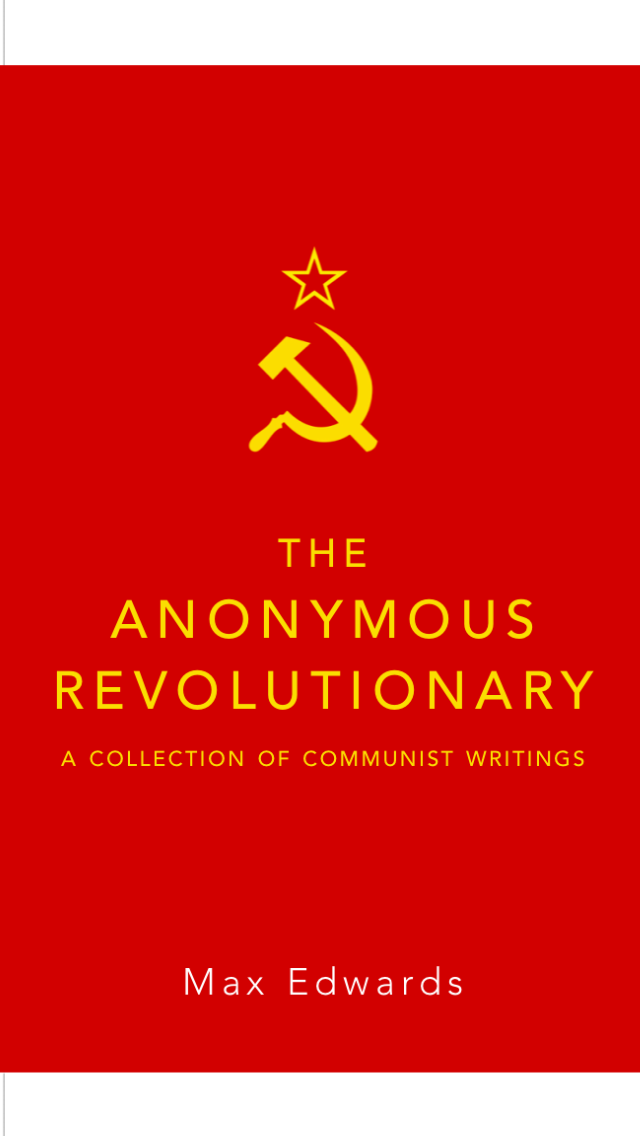
As some of you might know, this blog will be published as a book, documenting its first year. Its full title is The Anonymous Revolutionary: a Collection of Communist Writings, and a draft of its cover is displayed below:

There will be a book launch in the near future, a possible date for which is Friday 26th of February in London, but nothing is confirmed yet. I’m saying this as an early warning in case any of you wanted to come; please feel free! There may be a second book launch in York, where I live, but I don’t know any more yet.
Thank you for reading and following my posts and helping to get them published, and keep following this blog for more information…

– AR