Who do we Side With? – Assessing Relations in a Revolutionary Struggle 

The issues regarding the practicalities of revolution have, for a long time, divided opinions within communist circles. Karl Marx provided a theoretical basis for almost all things Marxist, from the alienation of the worker in capitalist society to the scientific progression of history, but this was one area which seems to have been glossed over, allowing the theorists and activists in his wake to devise individual interpretations. From this fresh wave of contributions to Marxist philosophy there arose Lenin’s model of a Vanguard Party, Luxembourg’s critique of Bolshevism in favour of revolutionary democracy, and Pannekoek’s concept of council communism, an idea which surfaced some years later in Tito’s Yugoslavia.

One issue in particular, which spurred significant international debate in the years following the Russian Revolution, was that of association. Many communists were prepared to work with other parties and organisations to advance their goal of revolution, whilst others insisted on a somewhat Puritan approach, refusing to affiliate themselves with any counter-revolutionary or bourgeois movements. This rift in opinion helped to alienate the Bolsheviks from a number of former allies, which, taking the ‘Puritan’ stance, became known loosely as the communist left or the ‘ultra-leftists’, a faction which still plays a role in the contemporary socialist movement.

So, if, in the context of revolution, the debate is still open as to who Marxist organisations should be prepared to side with, how should one go about answering this question? Who should be regarded as allies, and who should be renounced in the struggle for communism?

One occasion on which this question was brought to light was in 1921, during a period of unrest that occurred in the Communist Party of Italy (PCd’I) following the Comintern’s policy of adopting a ‘united front’, bringing together many worker’s movements and associations to strengthen the fight against capitalism. Prominent ultra-leftists in the party, such as Amadeo Bordiga, were greatly opposed to the idea and refused to work with the reactionary Italian Socialist Party, from which the communists had recently broken away.

Whilst this stance may seem an admirable and dogmatic one, it is important to remember that it is not as though the Bolsheviks (the leading forces in the Comintern) were an opportunist party; they had previously opposed any kind of alliance with reactionary organisations, yet the decision to foster unity between all socialist movements came following a lull in the revolutionary optimism which had swept through Europe following 1917, and a reinstatement of capitalist authority, forcing them to find alternative strategies to weaken capitalism and promote working-class organisation.

The logic of Bordiga and the likes, who eventually lost control of the party to a pro-Moscow group in the PCd’I, prevents this kind of thinking. It asserts that we must form no alliances with counter-revolutionaries no matter what, even if such an alliance would advance the revolution’s goals, and thus, through its rejection of such tactical and pragmatic actions, comes into conflict with the essentially Marxist logic of prioritising revolution over any other political goals. This is the reason why it needs stating that ‘left communism’ or ‘ultra-leftism’ does not deserve its leftist connotations; all that divides Lenin and Bordiga is a practical realisation of the revolution’s immediate tasks on the part of one, and a pompous, counter-productive ignorance of such on the part of the other. It is no coincidence that Russian Bolshevism, not Italian ultra-leftism, proved victorious in the defeat of the bourgeois and the creation of a proletarian dictatorship.

Today, there is an important lesson to be learned from this: one should respect general principals, such as the necessity of distancing oneself from counter-revolutionary people and organisations, but should be ready to break with that principal if it coincides with communist interests. Obviously, it’s unlikely that anyone would cling onto such ideas knowing that they clash with the revolutionary goals; for example, Bordiga undoubtedly rejected Comintern policy with the interests of the proletariat at heart, yet this is due to a failure to see or acknowledge that the Leninist approach (a pragmatic, logical, and ultimately productive manner of thinking) is far superior, and that tactical unity with organisations that may have opposing interests, alongside other sacrifices, may be necessary.

It’s worth pointing out that, at the time the Comintern introduced this policy, there were only two countries in Europe (Russia and Hungary) to have undertaken a successful and independent communist revolution, and in both cases, examples can be found where such sacrifices were necessarily made. To focus on Hungary in particular, it’s fact that the Communist Party took power by merging with the Social Democrats, after which point they established the Hungarian Soviet Republic, set about a program of radical social reforms, and reorganised the economy in a revolutionary manner. If they didn’t partake in this merger, sacrificing leftist principles for a socialist reality, such change would never have occurred.


Perpetuating the Cycle of Violence 

The recent terror attacks in Paris have spurred much debate on terrorism, with many taking the view that action needs to be taken if we’re to prevent anything like this from happening again. French President Hollande himself declared war on Islamic State, announcing plans to intensify airstrikes in the region, and he’s not alone; British Prime Minister David Cameron also proposed British intervention in the area, and talk is now underway of an international coalition to fight ISIS militants. Yet how effective are these measures actually going to be?

It’s worth remembering that Islamic State, whilst taking responsibility for these atrocities, announced that they were carried out in retaliation for France’s recent actions in the Middle East. Thus, it seems bizarre that the country is choosing to respond to a disasterby committing more of the same actions that inspired this disaster in the first place, especially since, as we are surely beginning to realise by now, they don’t work.

The western powers have organised countless attacks in this part of the world, destroying many innocent lives and communities in the name of stamping out terrorism, and, through the continuation of western social imperialism, have achieved nothing, for Islamic fundamentalism is just as pressing an issue as ever. In fact, I think we can say that imperialism shares a large portion of the blame for the existence of these organisations in the first place; according to Pelp and Feldman’s research*, 95% of suicide attacks are the result of foreign occupation. Given this unsurprising trend, showing that aggressive military action in ones country will likely turn its citizens against yours, we can see that an increase in French airstrikes will only contribute to the already existing cycle of violence.

Yet whilst I’m surprised at their inability to see sense, I’m not surprised at the eagerness of France to resort to such violence, for this was the country that only recently helped to destroy the state of Libya, contributed to the violence in Mali, and, prior to the Paris attacks, backed US intervention in Syria and Lebanon. During these campaigns, alongside the many others carried out by the American-aligned nations, many atrocities occurred and many found themselves alienated from the western world, fuelling the bloodshed that took place last week in the French capital.

To wade deeper into the Syrian conflict, as Hollande has promised to do, shall only add fuel to the fire.

* http://www.amazon.com/gp/product/0226645606?ie=UTF8&tag=fopo-20&linkCode=as2&camp=1789&creative=390957&creativeASIN=0226645606

The Evils of Inaction: Capitalism and the Migrant Crisis

With thousands of refugees hoping to be granted asylum in Europe, the continent has responded to the crisis with much resentment. Only recently did anti-migration demonstrators bearing neofascist slogans take to the streets of Warsaw, completely dwarfing the pro-migration rally that had taken place the same day. Their opinions are undoubtedly shared by many across Europe, as we have seen, it’s not only ordinary citizens who are to blame; the use of tear gas and water cannons upon migrants at the Hungarian border shows outright hostility between governments and migrants, and the fact that Swedish opinion polls reveal a far-right, anti-immigration party to be the country’s most popular choice show that mob mentality isn’t just present on the streets.

In an attempt to at least respond to the event, the United Kingdom has agreed to accept a quota of 20,000 refugees. Even a relatively small contribution such as this one was met with disdain, with many fearing for the stability of the nation after such an influx. It’s evident that none of those talking of stability have ever lived in Syria.

One thing is clear: thousands are pouring to our wealthy, stable nations to escape war, poverty and discrimination, and it’s as if we’re doing everything we can to shut off the flow of people and put up our national boundaries. The refusal to accept quotas or the angst about allowing more citizens to one’s country may be justified by a belief that Europe can’t cope with the influx, or that we won’t be able to provide for these people, yet these ideas are almost laughable if you compare the provisional capabilities of France, Britain or Poland with those of the dishevelled states these migrants are flocking from. When we finally realised that we can’t ignore the issue, it’s as though we reluctantly did as little as possible to get around it. Take the UK, for example. I firmly believe it could provide for many more than 20,000.  Perhaps not without harming the grossly unequal hierarchy of wealth that dominates in Britain, but some sacrifice of wealth and resources is obviously needed. Unsurprisingly, the wealthy nations of the west are yet again unwilling to sacrifice theirs.

In this respect, the recent migrant crisis is part of a far larger problem, for it is well known, for example, that there is enough food in the world to feed everybody, yet some live in luxury while others starve. This reflects the economic disparity between nations of the first and third world, which remains a necessity for either’s existence, and will always be preserved by wealthy countries simply by their refusal to change it, and jeopardise their affluence. Thus, their refusal to act, to utilise the economy for purposes that contradict their interests, is an inherent evil of the international bourgeois.  Europe’s refusal to take more responsibility is only a new manifestation of the same old problem; the unwillingness of the wealthy to change the status quo. We can only hope that, when such change doesn’t come, there are enough voices out there to insist upon it.

Remembering October

Tonight, ninety-nine years to this day, occurred the October Revolution.

As (in my opinion) the most significant revolution, the most important event in the struggle against capitalism, and the greatest achievement of the international left, I decided to dedicate this entry to its anniversary…

Happy November 6th/7th comrades!

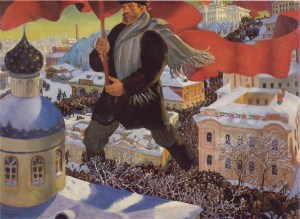
‘The Bolshevik’ – Boris Kustodiev

…Here’s some light musical accompaniment:

https://youtu.be/_sxTbfeYdO0